
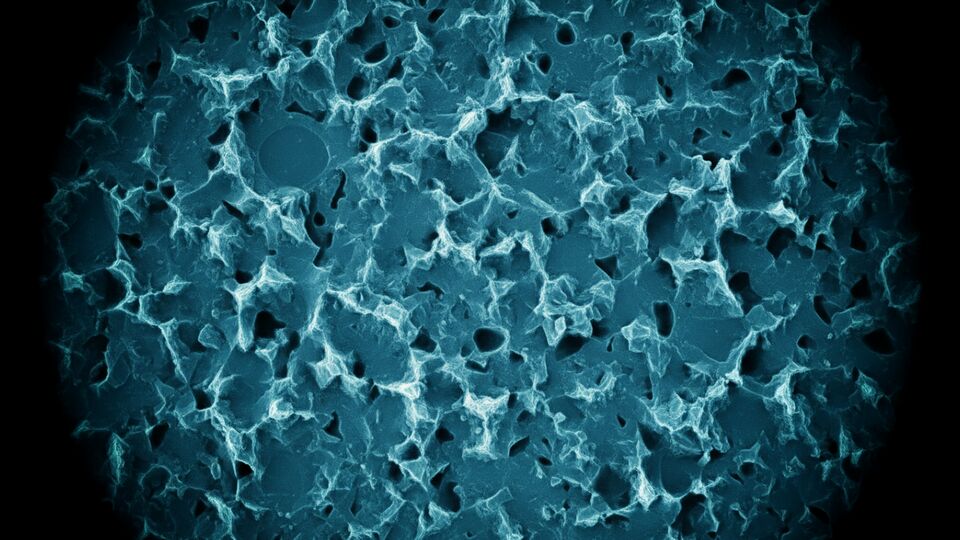
The implant surface is where biology meets engineering. Whatever happens at that interface in the first 12 weeks — the cell adhesion, the bone apposition, the stability transition from primary to secondary — determines whether the case succeeds. So when you’re evaluating an implant system, the surface treatment isn’t a detail. It’s the detail.
S.L.A. — Sandblasted, Large-grit, Acid-etched — is one of the most studied implant surface treatments in modern dentistry. Here’s what it actually is, what the data says, and why Nexplant uses it.
What S.L.A. does at the surface
The S.L.A. process creates a two-tier surface roughness on the titanium fixture:
- Macro-roughness from the sandblasting step — visible texture in the 20–50 µm range that mechanically interlocks with growing bone.
- Micro-roughness from the acid-etching step — a finer 1–2 µm topography that increases surface area and gives osteoblasts a preferred substrate to attach to.
The combined effect is roughly a 50% increase in the surface-to-RBM (resorbable blast media) ratio compared to a machined surface. That extra surface area gives the bone more places to grip, more places for protein adsorption, and more places for cell migration.
What the long-term data shows
S.L.A. has been one of the most-published implant surfaces over the past two decades. Across studies, three findings show up consistently:
- Faster osseointegration timelines. Compared to machined or smooth-surface implants, S.L.A. fixtures hit functional secondary stability several weeks earlier — meaningful when you’re scheduling a restoration.
- Higher BIC (bone-to-implant contact) at every time point. More direct bone contact along the fixture body — both early and at long-term follow-up.
- Predictable behavior in compromised bone. S.L.A. surfaces have shown reliable osseointegration even in D3 and D4 bone, where smooth surfaces struggle.
None of this is news to clinicians who trained in the past 15 years. S.L.A. is essentially the floor of acceptable implant-surface technology in modern dentistry. What matters now isn’t whether your system uses S.L.A. — it’s how cleanly the process is executed.
Why surface-treatment quality varies between brands
S.L.A. is a process, not a magic ingredient. Two manufacturers can both call their surface "S.L.A." and end up with very different results. The variables that matter:
- Particle size in the sandblast step. Too fine and you don’t get macro-roughness. Too coarse and you risk surface defects.
- Acid concentration and dwell time in the etch step. This is where micro-roughness is created, and it’s where most variability shows up.
- Post-treatment cleaning and packaging. Surface contamination from residual blast media or organic compounds can affect cell adhesion.
Nexplant’s S.L.A. process is calibrated for consistency at every step. Because we manufacture for high-volume practices, batch-to-batch variability isn’t something we can absorb — the surface has to behave the same on case 1 as it does on case 1,000.
What this means for your placement protocol
For high-volume clinicians, the practical implications of S.L.A. are:
- You can confidently plan immediate-load cases when bone density supports it — the surface gives you the early secondary stability needed.
- Your restoration timeline is predictable. 8–12 weeks for most cases, with reasonable confidence that secondary stability is there when you load.
- Your case planning in compromised bone is more forgiving. Even in D3/D4 bone, you have a surface that’s known to integrate reliably.
The takeaway
The S.L.A. surface isn’t a marketing claim. It’s a well-characterized engineering decision with two decades of supporting clinical data. What separates good implementations from great ones is process control — how consistently the surface comes off the manufacturing line.
Want the technical specs and case studies? Download the catalog, or talk to our sales team for a deeper dive.