
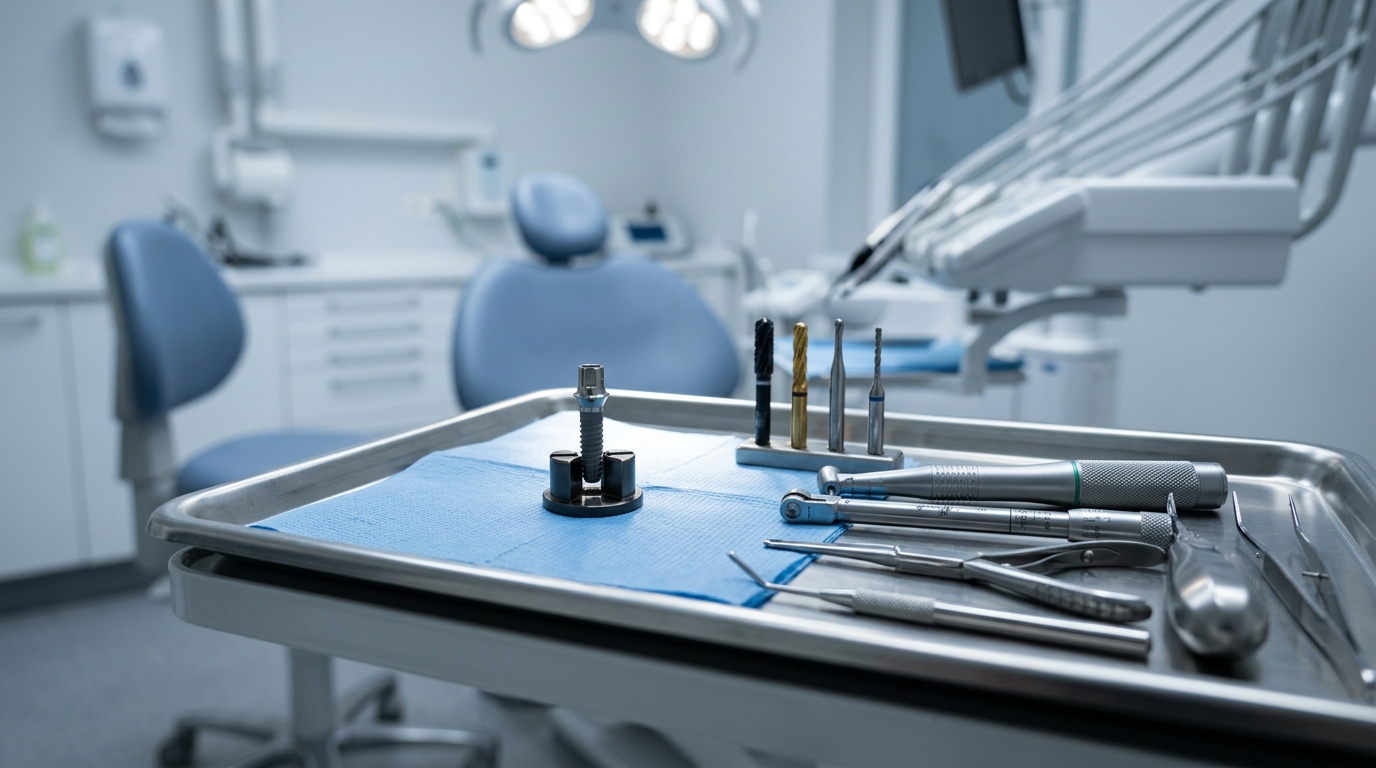
Immediate loading has moved from a boutique technique to a routine offering in well-run implant practices. Patients want fewer visits, fewer interim prostheses, and a tooth on the day of surgery. The biology and biomechanics that govern primary stability, however, have not changed. The clinicians who consistently succeed with same-visit protocols are not the ones with the most aggressive marketing — they are the ones with the most disciplined case selection and the clearest internal rules about when to defer.
This article lays out the decision criteria we use when deciding to place and restore in the same visit, the role of insertion torque and ISQ as complementary stability signals, and the specific places immediate loading quietly goes wrong in high-volume settings.
Defining the Protocol: Immediate, Early, and Delayed
Before we discuss criteria, the terminology has to be tight. Immediate loading refers to a definitive or provisional restoration placed in functional or non-functional occlusion within 48 hours of implant placement. Early loading covers the window from roughly one week to two months. Delayed loading follows conventional healing of three to six months. Within immediate loading, the distinction between immediate restoration (out of occlusion) and immediate function (in occlusion) is not semantic — it materially changes the biomechanical risk and the case selection threshold.
In a high-volume practice, most same-visit cases are immediate restoration of single units or immediate function of cross-arch full-arch prostheses splinted on four to six implants. The middle ground — immediate function on isolated posterior single units — is where we see the most preventable failures.
The Two-Signal Stability Model: Insertion Torque and ISQ
Primary stability is the prerequisite for immediate loading, and clinicians still argue about which metric to trust. The honest answer is that neither insertion torque nor ISQ is sufficient on its own.
Insertion torque measures the rotational resistance during placement. It reflects the friction between the implant and the bone walls and is heavily influenced by drilling protocol, thread design, and cortical engagement. A commonly accepted threshold for immediate loading is an insertion torque of at least 35 Ncm, with many clinicians preferring 45–50 Ncm for full-arch immediate function. Torque above roughly 70 Ncm is not a badge of honor; it raises legitimate concerns about compressive bone necrosis, particularly in dense D1 anterior mandible.
ISQ (Implant Stability Quotient), measured via resonance frequency analysis, reflects the stiffness of the implant’s interface with surrounding bone. Values are typically reported on a 1–100 scale, with ISQ above 70 generally considered favorable for immediate loading, 60–69 a caution zone, and below 60 a contraindication for loading without further healing. ISQ has the advantage of being repeatable at second-stage and useful for tracking osseointegration trajectory over time — insertion torque is a one-time measurement at placement.
The clinically robust position: use both. High torque with low ISQ suggests the implant achieved frictional grip but lacks the bone stiffness to support load — common in thin, dense cortical bone over poor cancellous support. Adequate torque (35–50 Ncm) paired with ISQ ≥ 70 in both mesiodistal and buccolingual measurements is the cleanest green light for immediate loading.
Case Selection: The Honest Criteria
Same-visit success starts long before the drill touches bone. The cases that reliably load immediately share most of the following:
- Bone quality D2–D3 with sufficient cortical engagement. D4 bone in the posterior maxilla is the single most common setting where clinicians overreach.
- Healed ridge or extraction socket with intact buccal plate. Immediate placement and immediate loading in a defective socket compounds risk.
- Sufficient bone volume to allow apical and palatal/lingual anchorage beyond the socket walls in immediate-placement cases — typically 4–5 mm of native bone beyond the socket apex.
- Favorable occlusal scheme with the ability to relieve the provisional from all centric and excursive contacts for single units, or cross-arch stabilization for full-arch.
- Controlled parafunction. A confirmed bruxer is not an absolute contraindication, but it is a reason to default to delayed loading or, at minimum, a rigid full-arch splint with a hard nightguard from delivery.
- Non-smoker or light smoker and well-controlled systemic status. Uncontrolled diabetes, active periodontal disease, and head-and-neck radiation history move the case to delayed.
The patient’s tolerance for risk also matters. A patient who explicitly cannot accept a second surgery or a temporary failure is, paradoxically, often the wrong candidate for immediate loading — because the technique trades short-term convenience for a non-zero early failure rate that delayed protocols do not carry.
Where Immediate Loading Goes Wrong in High-Volume Practice
Most immediate-load failures in busy practices are not biology — they are process. The pattern is consistent across the offices we work with:
- Torque worship. The surgeon hits 50 Ncm in dense D1 bone, declares the case loadable, and ignores an ISQ in the low 60s. Six weeks later the implant is mobile. High torque without confirming stiffness is the most common false-positive.
- Provisional occlusion drift. The chairside provisional is adjusted out of occlusion at delivery, then the patient returns two weeks later with a fractured incisal edge or a worn provisional that is now in heavy excursive contact. Loading protocols assume the provisional stays out of function; nothing in the patient’s life guarantees that.
- Cantilever creep on full-arch. Immediate full-arch prostheses delivered with cantilevers longer than 1.5× the AP spread, particularly with only four implants, concentrate load on the terminal fixtures during the most vulnerable healing weeks.
- Single posterior immediate function. An isolated immediate-loaded molar without a mesial or distal natural tooth contact to share load is a setup for micromotion above the osseointegration threshold — roughly 100 µm is the often-cited limit.
- Inconsistent protocol across operators. In multi-doctor practices, “we do immediate loading” means five different things. A written internal protocol — torque floor, ISQ floor, bone-type exclusions, provisional design rules — eliminates more failures than any single clinical refinement.
A Practical Same-Visit Decision Framework
Reduce the decision to a sequence that can be executed without debate at the chair:
- Pre-surgical: Confirm bone volume and density on CBCT, rule out parafunction red flags, confirm the patient consents to both immediate and delayed pathways.
- At placement: Record insertion torque. If < 35 Ncm, default to delayed loading regardless of other findings.
- Immediately after placement: Measure ISQ in two orthogonal directions. Require ≥ 70 in both for single-unit immediate function; ≥ 65 acceptable for non-functional immediate restoration; ≥ 70 average across full-arch implants for immediate function on a splinted prosthesis.
- Provisional design: Single units — no centric, no excursive contact, narrowed occlusal table, cleanable emergence. Full-arch — rigid cross-arch splint, cantilevers within AP-spread limits, balanced occlusion verified with articulating paper at delivery.
- Follow-up: ISQ recheck at four to six weeks. A stable or rising ISQ is the clearest evidence integration is on track; a declining ISQ is an early-warning signal that justifies de-loading or removal before clinical mobility appears.
Closing Thought
Immediate loading is one of the highest-leverage offerings in a modern implant practice — it shortens treatment, differentiates the practice, and, in the right cases, delivers outcomes indistinguishable from delayed protocols. The discipline that separates consistently successful operators is not technical bravado. It is the willingness to defer. Every immediate-load case you decline because the torque, ISQ, bone, or occlusion does not meet your written criteria protects the success rate of every case you accept. In high-volume practice, that math compounds quickly.