
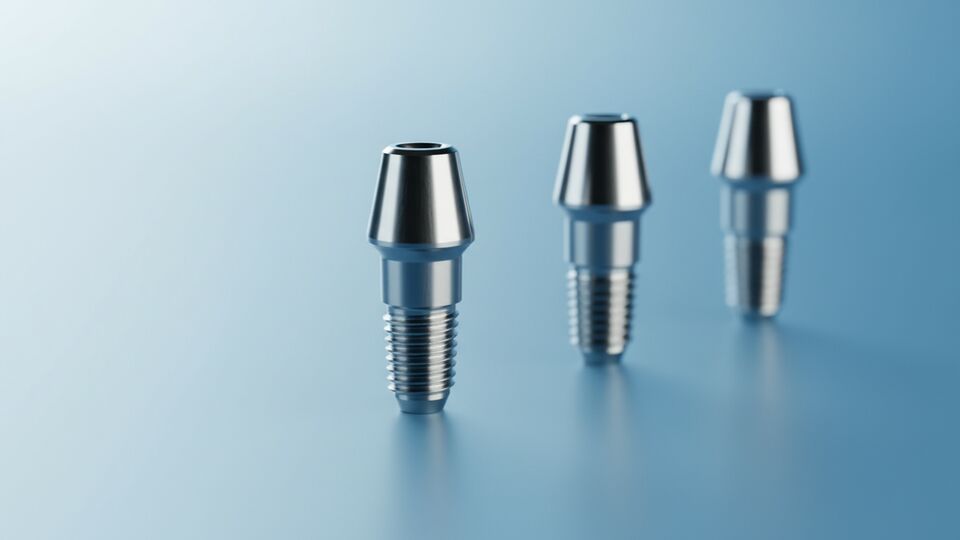
If your practice places one or two implants a week, the system you choose is mostly a clinical decision — pick the brand your residency trained you on and move on. But once you cross into 50, 100, or more implants a month, the math changes. The implant system becomes a line item, a workflow, a training cost, and a margin lever. At that volume, you’re not just buying a fixture. You’re buying an operating system for your implant program.
Here’s how the dentists, periodontists, and full-arch surgeons we work with evaluate a system before they switch.
1. Predictability over premium branding
Legacy implant brands charge a premium because they spent the past 30 years funding clinical research. That research matters, but a lot of it has been productized at this point — the engineering principles (tapered body, thread design, micro-rough surfaces, internal-hex or conical connections) are well-understood across the industry. What you’re paying extra for is the brand, the rep network, and a halo on the box.
For a high-volume practice, predictability matters more than premium branding. You need consistent primary stability across every case. You need an osseointegration timeline you can plan a restoration schedule against. You need a fixture that doesn’t embarrass you in your worst-case bone.
Those things are about engineering and quality control — not about how old the logo is.
2. A complete prosthetic line, or you’re paying twice
The single most expensive trap in implant brand selection: a fixture system without a credible prosthetic line. You buy fixtures from one company, abutments from another, full-arch hardware from a third, and now your lab is doing eight different impression workflows and the restorative team hates you.
Before you switch, make sure the system has every component you actually use:
- Healing abutments and cover screws in every diameter
- Custom and stock abutments — titanium and zirconia
- Multi-unit abutments for full-arch
- Impression copings, transfers, analogs (digital and analog workflows)
- Surgical kit with the drills you actually need, not a sales-staged showpiece
If any one of those is missing, you’re going to pay for it later in mixed-system case labor.
3. Pricing that scales with you
Premium brands price like they’re selling a service. Practical brands price like they’re selling a part.
At high volume, the difference shows up in your P&L. A $50 difference per fixture across 100 implants a month is $60,000 a year — enough to fund a hygienist, a scanner, or a marketing program. The dentists who scale implant programs are the ones who understand that the per-unit cost is a real number, not a vanity metric. A premium-quality system at a competitive price isn’t a downgrade; it’s a margin decision.
4. Surgical workflow consistency
When you’re placing a lot of implants, you want the surgical experience to be the same every time, regardless of diameter. The drilling sequence shouldn’t change between Mini, Standard, and Wide series. The drivers shouldn’t require a different torque wrench. The kit shouldn’t have hidden complexity.
Nexplant was designed around this principle from day one. One surgical kit. One drilling protocol. Three diameter series that share geometry where it matters. Your surgical team can run a full schedule of mixed cases without slowing down to look anything up.
5. The clinician-input filter
One of the simplest filters when evaluating an implant system: was this system designed by clinicians, or by engineers?
Engineer-led systems tend to over-engineer. They have features that look impressive in a brochure but don’t solve a chairside problem. Clinician-led systems — like Nexplant — tend to be quieter on paper, but they answer the questions you actually have at the operatory: can I correct angulation if my pilot drill drifts? Can I get primary stability in soft posterior bone? Can my hygienist take an impression without a 30-page manual?
The bottom line
If you’re running a high-volume implant program, your implant system is part of your business model. Switching to a premium-quality, clinician-designed system at a competitive price isn’t a compromise — it’s a strategic move that scales your margins as your volume grows.
If you want to talk through what that looks like for your practice, our sales team can walk you through pricing, kit details, and case studies in 20 minutes. Get in touch.